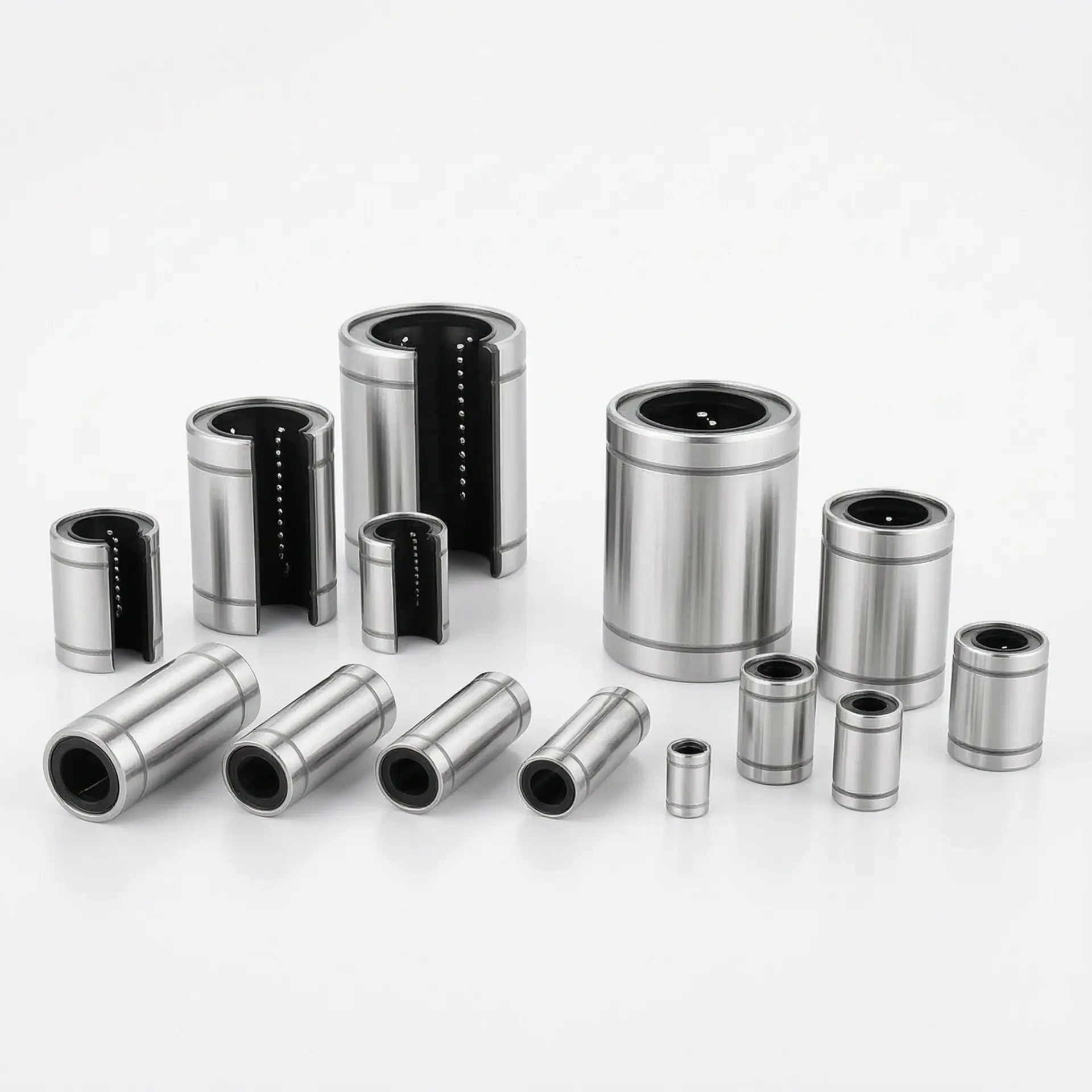
Choosing a linear bearing looks simple — match the shaft diameter and move on. In practice, four questions decide whether the axis runs for ten years or ten weeks: what load does it carry, how fast does it cycle, what environment does it live in, and how is it mounted?
1. Start with load direction and magnitude
Ball bushings carry load in the radial plane. If the axis sees overturning moments — a cantilevered tool plate, a tall gantry — a pair of standard LM bushings on end-supported shafts will flex. That is the case for open-type bushings on SBR supported rails, or for a profile guide such as the HGH/HGW series where the rail resists moments directly.
2. Match the sealing to the environment
Dust, chips and coolant kill unsealed bushings. Double-sealed LM…UU types retain grease and exclude contamination, and are the default for woodworking, packaging and general factory floors. For washdown or humid environments, stainless steel bushings and shafts eliminate the corrosion path entirely.
3. Choose the mounting form last
Flanged bearings (LMF/LMK/LMH) bolt directly to a carriage and save a machined housing; standard LM bushings pressed into a housing give better alignment control in precision frames; SCS housed blocks are the fastest route for prototypes and light machinery.
- Standard LM — press-fit into machined housings, precision frames
- Flanged LMF/LMK/LMH — direct bolt-on, compact carriages
- Open LM-OP + SBR rail — long strokes, heavy loads, no deflection
- Stainless LM-SUS — food, medical, humid environments
Send us your load, stroke, speed and environment — YZXQ’s engineering team will confirm the bearing type, clearance and matching shaft specification within one working day.
Send Your Model List — Get a Factory Quote from Our Factory Team
Share your models, quantities and destination port. Our export team replies with pricing, lead time and freight options.